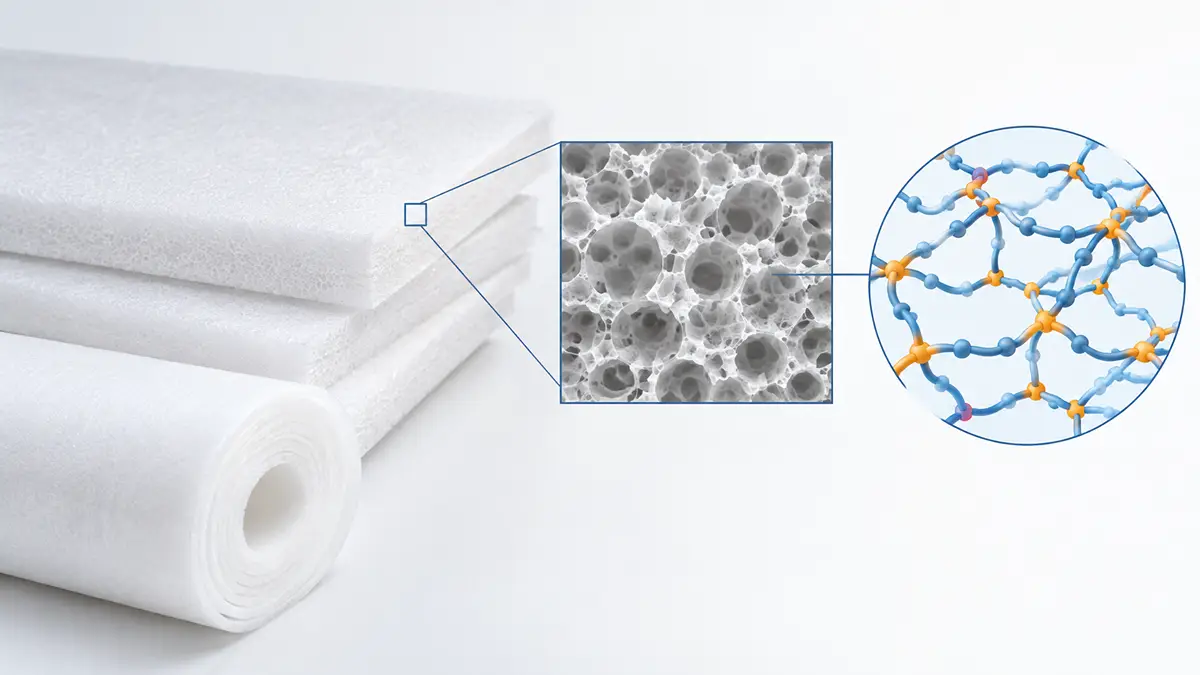
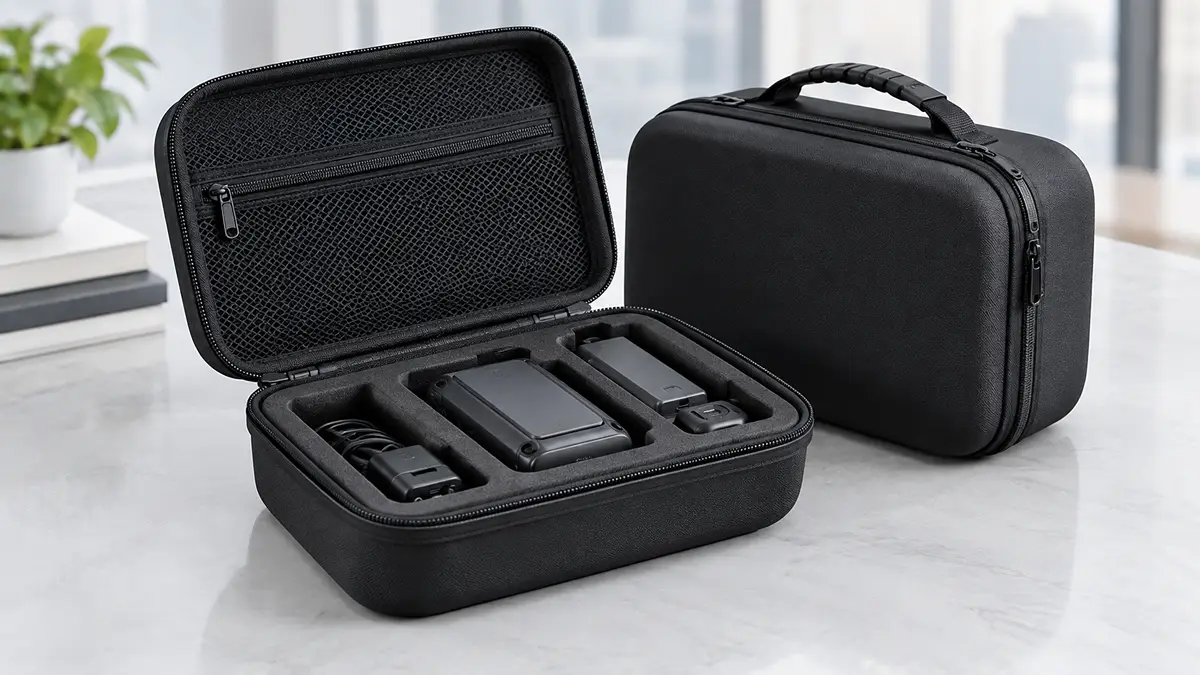
Sourcing EVA foam without verifying the density and hardness tolerances often leaves procurement teams with inserts that leak protection at the seams or packaging that permanently deforms under load. Getting the material call right, before a supplier cuts tooling, is what separates a quiet production run from a scrap pile.
This guide benchmarks typical commercial EVA foam grades: vinyl acetate ratios, density ranges, durometer scales, and cell structure. We also explain how a case factory like ours selects and converts the material, so you can read a supplier’s technical data sheet and know which numbers actually matter for your product.
What Does EVA Stand For
EVA stands for ethylene-vinyl acetate, a versatile copolymer whose physical properties shift with the ratio of its two chemical monomers.
The Chemical Definition
EVA is produced by copolymerizing ethylene with vinyl acetate. The resulting material behaves like a thermoplastic in processing but retains rubber-like flexibility in service. The two monomer segments do different jobs inside the same chain:
- Ethylene segments: provide structural toughness, chemical resistance, and semi-crystalline behavior similar to polyethylene.
- Vinyl acetate segments: interrupt crystallization, adding flexibility, tactile softness, and impact absorption.
By adjusting that ratio, producers tune the base resin anywhere from stiff, structural grades to soft, elastomeric sheet.
How the Polymer Transitions Into Foam
Raw EVA resin pellets are solid plastic. They become the cushioning material used in industrial components through a thermal expansion step, and the conversion has three parts:
- Compounding: the resin is blended with blowing agents, cross-linking agents, and pigments.
- Expansion: heat softens the polymer and the blowing agent releases gas, forming tiny cells.
- Cross-linking: chemical bonds tie the polymer chains into a network that resists permanent cell collapse under load.
The result is typically a closed-cell matrix. Because the individual gas cells remain sealed off from each other, the finished sheet naturally resists water absorption and holds buoyancy over time.
Why Vinyl Acetate Ratios Dictate Performance
- Commercial range: foam formulations commonly contain between 8% and 40% vinyl acetate by weight.
- Low ratios: produce more crystalline, rigid foams with firmer structural support.
- High ratios: yield softer, more elastic cushioning that typically stays flexible in sub-zero conditions.
Specifying the correct vinyl acetate percentage matters in sourcing. A mismatch can leave you with an insert that is either too brittle for cold-chain logistics or too soft to locate heavy components in a case.
How EVA Foam Is Manufactured
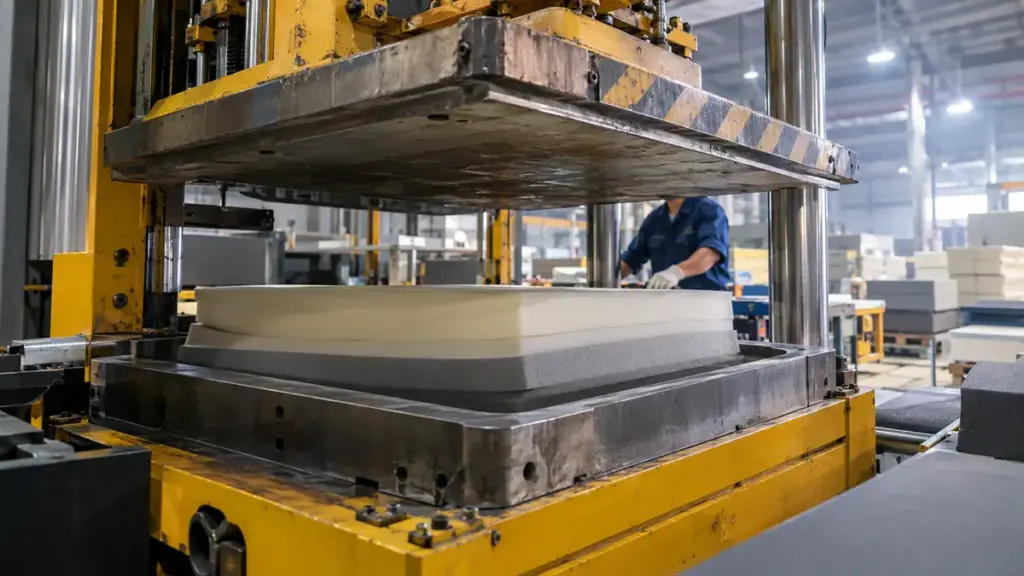
Controlling temperature and cross-linking during expansion turns raw copolymer into closed-cell sheets and molded parts. Case manufacturers enter the chain after this stage, converting those sheets into finished products.
How does a handful of plastic pellets become the shock-absorbing midsole of a running shoe? The thermal window during production determines whether the result is high-rebound cushioning or a warped, unusable slab. Three stages cover most of what a buyer should recognize.
Formulation and Compounding
Producers blend the base resin with additives before any expansion happens. Typical compounding inputs, per published supplier data, look like this:
- Base copolymer resin: the structural backbone, with vinyl acetate content customized between roughly 8% and 40% by weight.
- Blowing agents: commonly azodicarbonamide, which decomposes into gas under heat.
- Cross-linking promoters: organic peroxides that tie the chains into an elastic network.
- Thermal compounding: internal mixers or extruders blend the batch at controlled temperatures kept below the blowing agent’s trigger point, preventing premature foaming.
Molding and Expansion
Compression molding is the workhorse route. Compounded slabs are placed into heated metal molds; under clamping force the blowing agent decomposes while the peroxides cross-link the polymer, capturing gas inside discrete sealed cells. Releasing press pressure lets the block expand to roughly two to three times its molded volume. Continuous extrusion and foam injection molding serve higher volumes: extruders output uniform rolls for underlay and padding, while injection units produce net-shape parts such as footwear outsoles.
Small swings in temperature, pressure, or chemical ratios shift the final properties. Too much peroxide can leave a brittle network; too little tends to produce excessive compression set. This is why batch-to-batch documentation, not a single sample, is the real evidence of a foam supplier’s control.
Post-Processing and Conversion
Foam blocks exiting the mold are thick, uneven, and skinned. Fabricators split them into sheets (often down to a few millimeters), laminate faces with fabric, rubber, or pressure-sensitive adhesive, and die-cut or CNC-cut the finished shapes. This is the stage where protective case factories work: our line takes certified EVA sheets, laminates the chosen face fabric, then heat-forms, trims, and stitches each shell. The full sequence is covered in our guide to EVA cases.
Core Properties of EVA Foam
The copolymer formulation and expansion parameters dictate mechanical performance, balancing lightweight closed-cell structures against defined chemical and thermal limits.
Which grade survives your operating environment? The answer sits in four property groups: physical composition, mechanical response, thermal behavior, and chemical limits. The figures below are typical published ranges for commercial grades; treat them as a briefing baseline and verify actual values against the supplier’s technical data sheet for your lot.
Density and Hardness Are Separate Specs
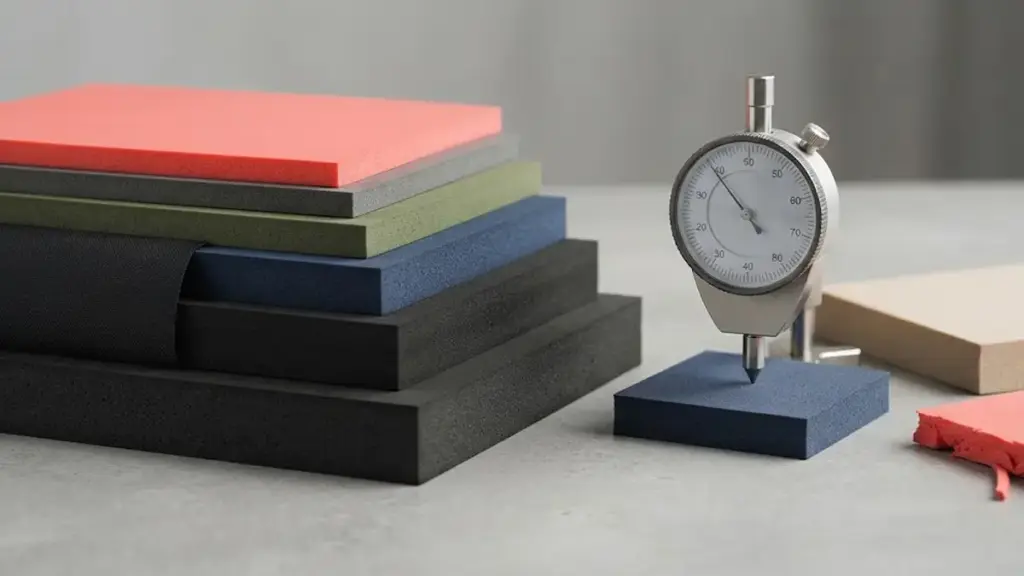
Conflating density with hardness is a fast route to a ruined production run. Density is mass per unit volume, usually measured in kg/m³ under standards such as ASTM D3575 or ISO 845. Hardness (durometer) measures resistance to surface indentation, commonly under ASTM D2240. By changing expansion ratios and cross-linking levels, producers can supply two foams with the same density and entirely different deflection behavior.
| Density Range (kg/m³) | Typical Hardness Range | Common Applications |
|---|---|---|
| 30–50 | Shore 00, about 45–50 | Lightweight cushioning, packaging inserts, craft sheets |
| 50–80 | Shore C, about 15–30 | General-purpose pads, industrial gaskets, sports protective gear |
| 80–120 | Shore C, about 35–50 | Footwear midsoles, tool organization inserts, marine traction pads |
| 120–200 | Asker C, about 50–70 | Firm structural padding, durable outsoles, load-bearing parts |
| 200–400 | Shore A, about 40–70 | High-density seals, rigid spacers, structural components |
Note that durometer scales do not convert cleanly into one another. A Shore A reading is not a Shore C reading, and procurement errors frequently start there. Always specify the exact scale, plus the testing temperature, on the purchase document.
Mechanical, Thermal, and Chemical Limits
- Compression behavior: commercial grades commonly publish compression strength in the tens of kPa at 25% deflection, with compression set values roughly between 9% and 14%; exact figures vary by grade and should be read from the TDS.
- Tensile and tear: published tensile strength and tear resistance differ widely across densities; request measured values for the specific lot.
- Thermal insulation: the sealed gas cells give low thermal conductivity, which is why the material appears in thermal packaging; service temperature windows for standard grades are often cited around −70°C to +70°C, with shrinkage risk at the upper end.
- Chemical exposure: the foam resists water, salt solutions, and dilute acids and alkalis, but hydrocarbons, chlorinated solvents, ketones, and hot oils can cause swelling and degradation.
- UV and flammability: unprotected foam is susceptible to UV cracking unless stabilizers are used, and as a combustible polymer it typically needs flame-retardant additives to pass horizontal-burn requirements such as FMVSS 302.
What Actually Drives Grade Selection
Three levers during production set where a sheet lands on the property table: vinyl acetate content (softness and low-temperature flexibility), cross-link density (recovery, thermal limit, compression set), and expansion control (final density and cell uniformity). A useful real-world example from our own purchasing: we standardize on a higher-hardness 75-grade, 6 mm EVA sheet as the default stock, while the regional trade norm is a softer 65-grade, 5 mm sheet. The extra hardness and thickness are what let a thin case wall resist crushing in transit without adding grams the product cannot carry.
Compliance: RoHS, REACH, and Why It Belongs in the Spec
For EU-bound products, material compliance is a specification, not a nice-to-have. The base EVA material itself contains no added heavy metals or plasticizers of concern, but additives, face fabrics, laminating adhesives, and hardware can each introduce restricted substances. European buyers typically ask for REACH SVHC and RoHS test reports; several US buyers add California Proposition 65. In our factory, REACH- and RoHS-compliant material is the default for every order rather than a paid upgrade, and we hold the environmental assessment documentation most regional shops skip.
From Spec Sheet to Purchase Order
- Request the TDS early: density, hardness with scale named, compression set, and the test standard behind each number.
- Verify on physical samples: measure or have the lot tested; do not accept catalogue values as lot values.
- Freeze the specification in writing: values, tolerances, color, thickness, skin condition, and compliance documents.
- Inspect against the frozen spec: pre-shipment checks compare the production lot to the approved sample, not to the datasheet.
Closed-Cell vs Open-Cell EVA
Closed-cell EVA seals out moisture and carries load; open-cell EVA allows airflow, absorbs sound, and compresses more softly.
Selecting the wrong cell structure for a component leads to early failure: a sponge that drinks water, or a liner that never breathes. The difference comes from how the microscopic cells form during expansion.
Structural Differences
- Closed-cell: sealed, isolated cells restrict liquid penetration; water absorption in well-formed sheet typically stays below 2% by volume.
- Open-cell: interconnected pores let air and moisture migrate through the material.
- Density profile: closed-cell commercial grades generally span about 30 to 400 kg/m³, trading weight against stability.
How Each One Behaves Under Load and Moisture
Sealed gas cells resist convective heat transfer, which supports insulation value; the same structure gives firmer load-bearing response and slower moisture pickup. Open-cell formulations compress with a softer feel and dissipate airborne sound through viscous friction in the pore network, but carry less load and recover more slowly. In footwear and gasketing, long-term dimensional recovery is usually described by compression set, whichever structure you specify.
Typical Use Cases
- Closed-cell: marine and outdoor gear, gaskets and low-pressure seals, tool inserts, and protective packaging, including the case shells we form.
- Open-cell: acoustic panels, breathable linings and orthotic covers, and filtration or fluid-transport components.
Where EVA Foam Is Used
Footwear, marine, packaging, and medical applications all draw on the same short list: closed-cell water resistance, shock absorption, and easy fabrication.
Knowing where the material earns its keep helps you match density and hardness to the job instead of over-specifying every line item.
Footwear and Athletic Gear
Shoe midsoles and insoles use EVA for shock absorption and pressure distribution; impact padding inside helmets, gloves, and shin guards relies on its energy return; moisture-resistant yoga blocks and interlocking gym tiles take advantage of the closed-cell structure that wipes dry.
Marine and Aquatic Products
Standard open-cell foams soak up water in marine duty. EVA’s sealed cells resist moisture while staying buoyant, which is why it appears in boat decking, swim platforms, surf pads, life-jacket flotation cores, and slip-resistant rod and paddle grips.
Protective Packaging and Case Inserts
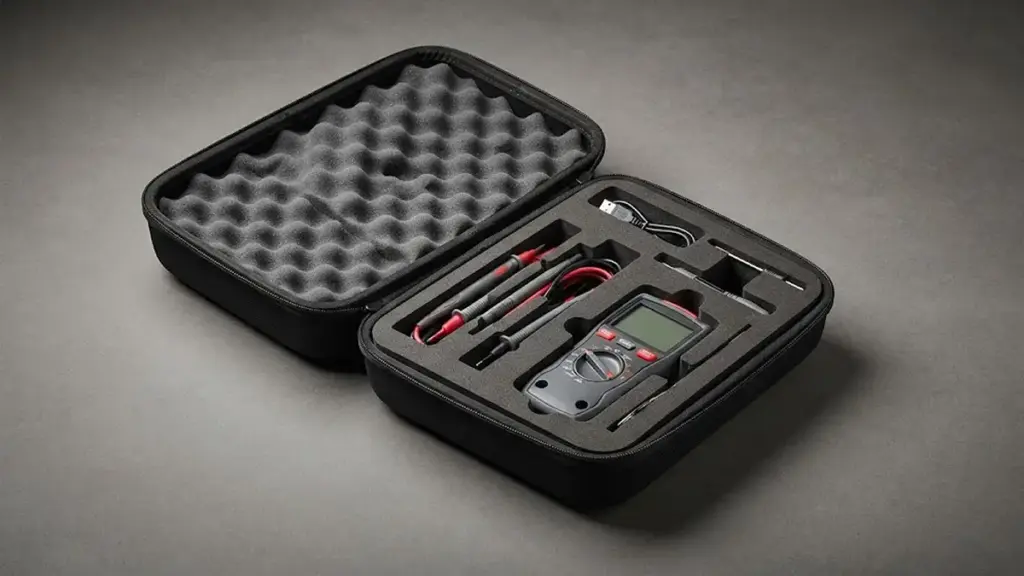
This is our core business. Custom-fit case inserts, tool shadow boards, and shipping dunnage protect electronics, instruments, and precision tools by absorbing drop energy and blocking vibration. Higher-density grades carry heavier instruments; lower-density zones cushion lids and fragile peripherals. The shell construction, liner choices, and hardware options are laid out in our EVA case buyer’s guide linked above.
Medical Devices and Consumer Products
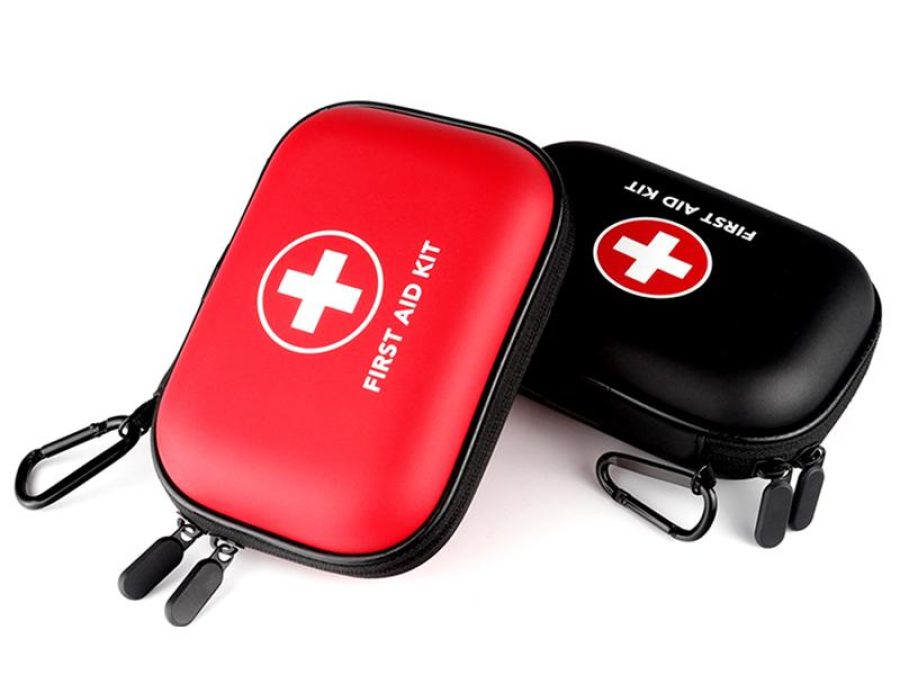
Medical instrument cases need wipe-down surfaces and traceable materials, which pushes buyers toward compliant EVA grades with documented REACH and RoHS test reports. Outside healthcare, the material shows up in orthotic supports, heat-formed prototypes and props, and building underlayment and expansion joints. Wherever the use, the same rule applies: pick density, thickness, and hardness for the real environment, then test the assembled product under actual conditions.
EVA vs PE vs PU Foam
Choosing between EVA, PE, and PU comes down to matching cell structure and rebound behavior to your mechanical, moisture, and thermal requirements.
All three are foam; they differ in what happens when a buyer pushes them outside their comfort zone. EVA combines rubber-like flexibility with clean die-cut edges and reliable recovery under repeated compression, though it softens above roughly 60–70°C service heat. PE is the economical workhorse for stiff, structural protection and its cross-linked variant adds thermal margin. Flexible PU wins on soft conformity but holds moisture and can take a permanent set under sustained load.
| Attribute | EVA Foam | PE Foam | PU Foam |
|---|---|---|---|
| Cell structure | Mostly closed-cell | Closed-cell | Mostly open-cell (flexible grades) |
| Moisture uptake | Very low | Very low | Absorbs water |
| Feel and recovery | Firm-soft, good rebound | Stiff, lower conformity | Softest, slow recovery possible |
| Fabrication | Clean die-cut, thermoforming, bonding | Simple cutting and laminating | Foam-in-place and slab conversion |
| Typical role | Reusable cases, midsoles, sports padding | Cost-effective shipping protection, insulation | Furniture, seating, acoustic comfort |
If your shortlist includes cross-linked polyethylene specifically, our dedicated breakdown of cross-linked PE foam covers how the XLPE network forms and where it outperforms standard PE and EVA.
Frequently Asked Questions
What does EVA stand for in EVA foam?
EVA stands for ethylene-vinyl acetate, a copolymer of ethylene and vinyl acetate monomers. Ethylene contributes structural strength and thermoplastic processability; vinyl acetate adds flexibility and low-temperature elasticity. Expanding the resin with a blowing agent yields a lightweight, resilient closed-cell foam.
Is EVA foam waterproof?
The material itself resists water because closed-cell EVA traps gas in sealed pockets, keeping absorption very low. Finished assemblies, however, can still let water in through unsealed seams, zippers, stitching, or raw cut edges, so the design of the product matters as much as the foam.
Is EVA foam toxic or safe?
Cured EVA polymer is chemically stable and inert at room temperature. New products can carry temporary manufacturing odors or light VOC release from additives, which usually dissipates within a few days of airing. For regulated markets, request REACH SVHC, RoHS, or Proposition 65 test reports covering the actual lot rather than the generic resin.
Can EVA foam be recycled?
EVA is recyclable in principle, but curbside programs rarely accept it, and chemically cross-linked grades do not simply melt down. Industrial processors grind clean scrap into crumb or powder for floor underlays, composite mats, and playground surfaces, so factory offcut streams are the practical recycling route.
What temperature can EVA foam handle?
Standard grades are commonly rated for service temperatures well below freezing up to roughly 60–70°C, with published limits varying by formulation. Above that range the material softens and can distort, which is exactly why it thermoforms into case shells, but also why a parked car in direct sun is a real test for any EVA product.
Final Thoughts
Cheaper, unverified foam can look attractive on a quote and expensive on a returns report. Density, durometer with a named scale, compression set, and compliance documentation are the four numbers that decide whether a component survives its service life, and they belong in your purchase specification before tooling starts.
If you are developing a custom case or insert, ask prospective suppliers to show material test reports for the actual lot, plus a formed sample measured against your frozen spec. That is exactly how we work: REACH- and RoHS-compliant materials by default, a 75-grade 6 mm EVA stock standard, and samples checked against your documentation before mass production begins.