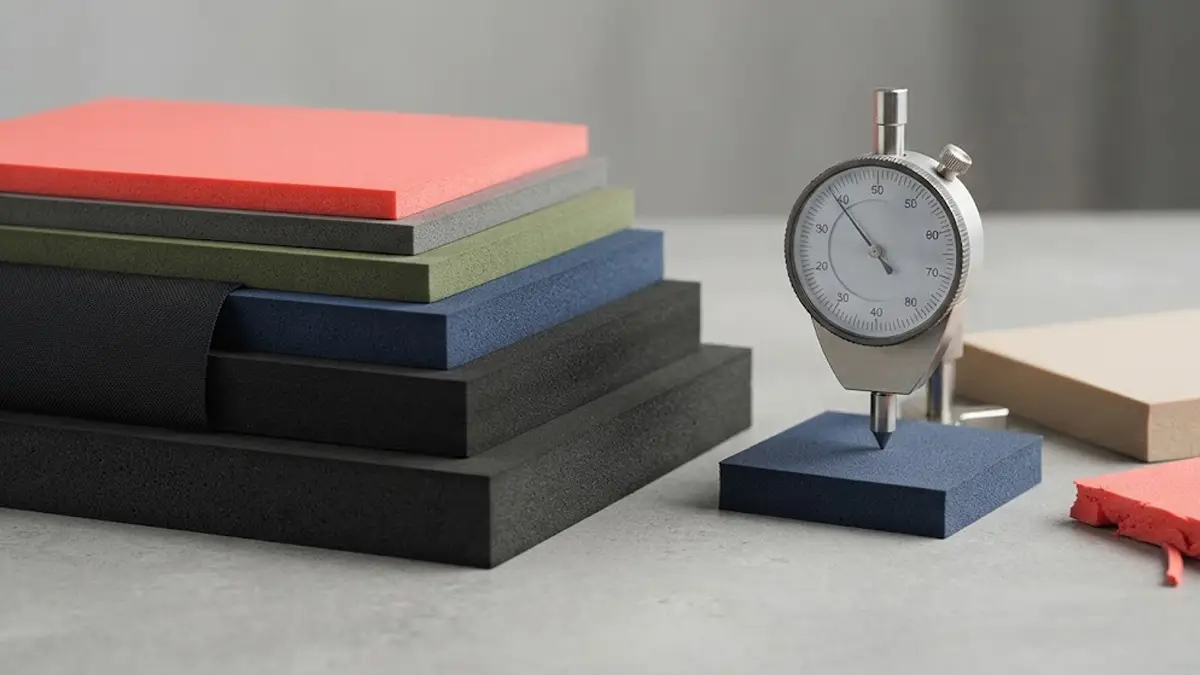
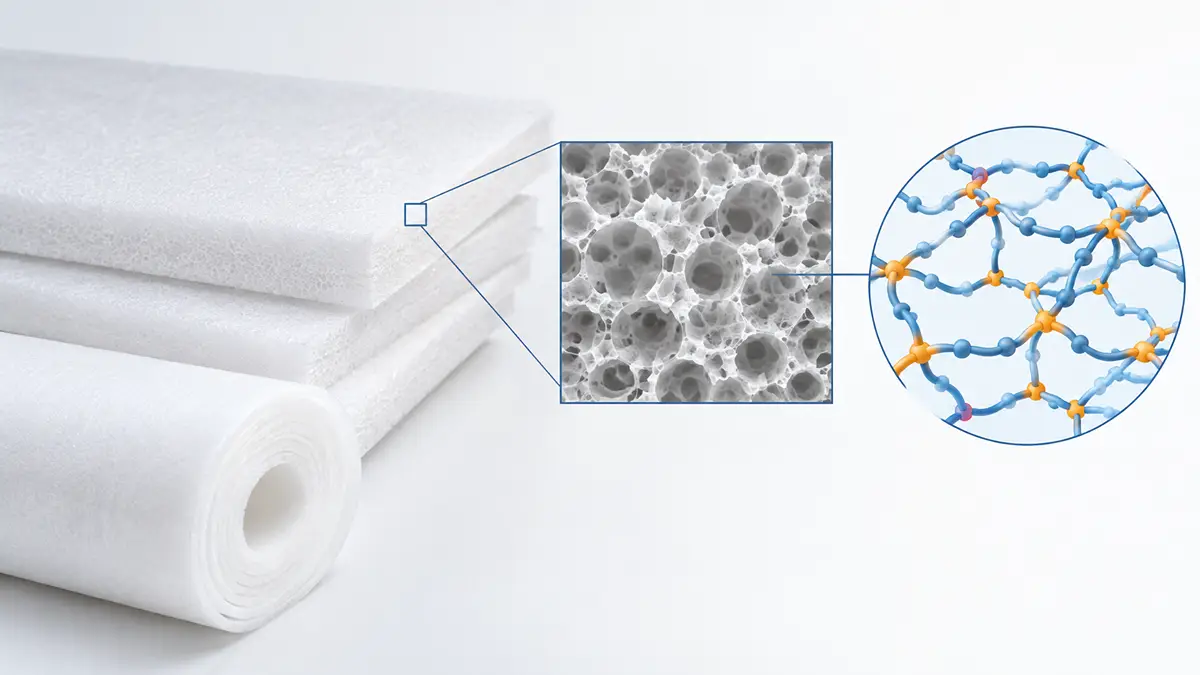
A density figure copied from a supplier datasheet, accepted without tolerance or test standard, ends in one of two failures: inserts that pack down and stay flattened under load, or over-specified foam that adds grams and unit cost to a product that never needed them. Neither outcome is prevented by quoting Shore hardness on its own.
This guide covers what EVA foam density actually measures, how it is tested under ASTM and ISO protocols, the commercial grades you will be quoted, why density and hardness are separate line items on a spec sheet, and how the grade choice moves protection, peso, e custo. It closes with the sourcing sequence for locking a specification down before a production run.
What Is EVA Foam Density
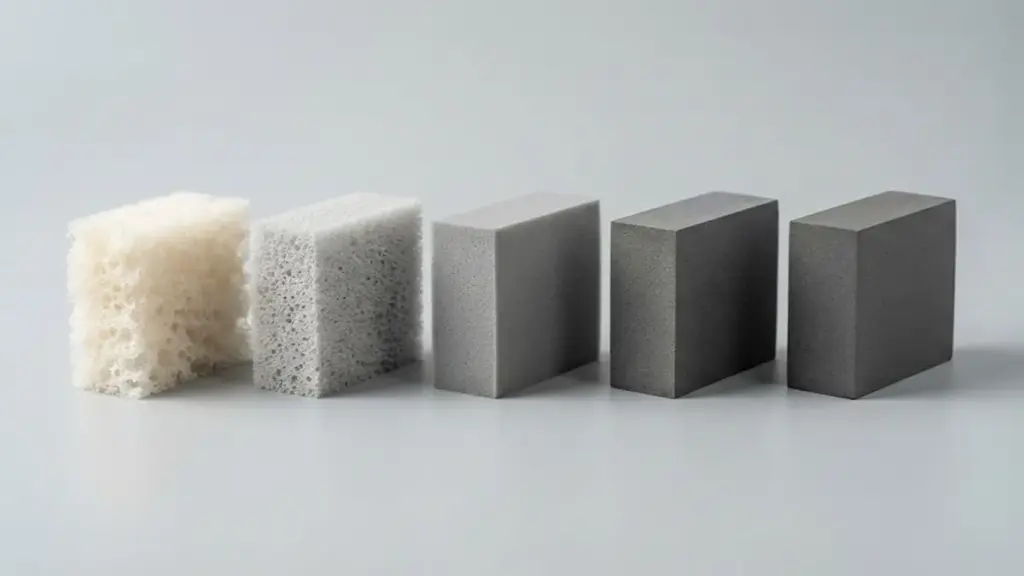
EVA foam density is the mass of closed-cell material per unit volume. It reflects how much solid polymer sits inside the sheet relative to trapped gas, and it moves weight, load support, and material cost together — independently of how firm the surface feels.
Density measures the physical mass of ethylene-vinyl acetate and its additives contained in a given volume of foam. Because the material is closed-cell, the reading captures both the solid phase and the gas bubbles locked inside it. That combined reading — apparent density — is the number that appears on quotation sheets and inspection reports, and it is the number a procurement team can actually verify on receipt.
Procurement documents express it in three unit systems. Learning all three prevents unit mistakes in cross-border quoting:
- Kilograms per cubic metre (kg/m³): the primary metric in international technical specifications, and the unit most Chinese and European factories quote in.
- Grams per cubic centimetre (g/cm³): common in laboratory reports; 1 g/cm³ equals 1,000 kg/m³.
- Pounds per cubic foot (PCF): the North American trade unit; 1 lb/ft³ converts to roughly 16.02 kg/m³.
Commercial closed-cell EVA spans roughly 20 para 270 kg/m³ (about 1.2 para 16.9 PCF). Within that span, the case-insert and shell-lining grades cluster between 30 e 80 kg/m³; further up the scale sit flooring, calçados, and structural parts. The material family behind these numbers — what EVA is, how it is produced, and how it behaves — is covered in our guide to what EVA foam is; this article stays on the density decision.
How Density Is Measured
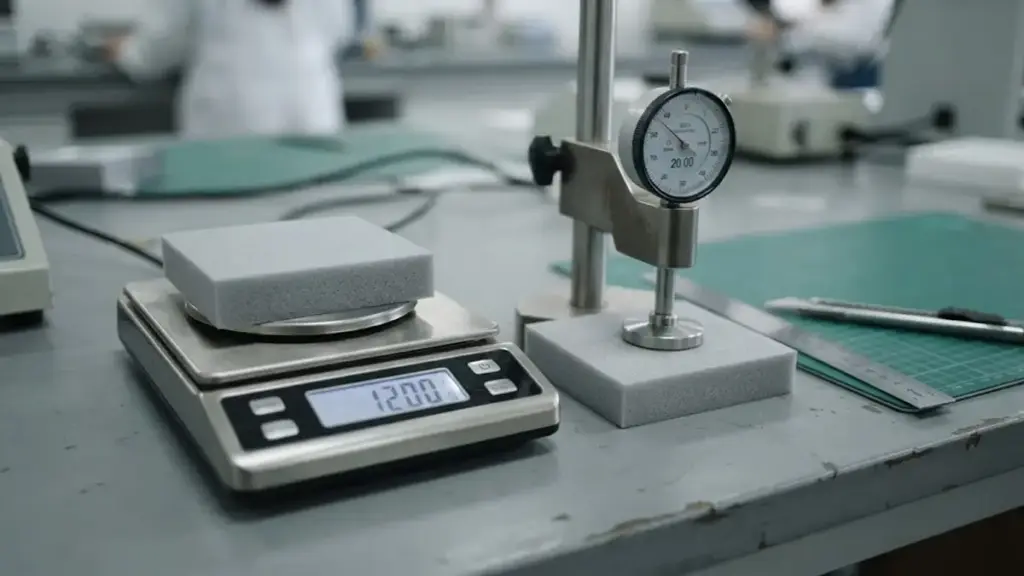
Accurate density measurement depends on specimen preparation as much as on the balance: skins, laminations, umidade, and careless cutting all shift the reading.
The Calculation Behind the Number
Apparent density is the mass of a representative sample divided by its volume, with volume taken from length, largura, and thickness for rectangular specimens. The result describes the foamed product, not the raw resin: because blowing agents trap gas inside the cells, the same polymer that reads about 0.95 g/cm³ unfoamed can deliver sheets at a twentieth of that figure.
Testing Standards You Will See on a Report
Quoted values are only comparable when both parties test to the same protocol. The four that appear most often in EVA trade documentation:
- ASTM D1622: standard procedure for the apparent density of rigid and semi-flexible cellular plastics, distinguishing overall readings (with skins) from core readings (skins removed).
- ISO 845: the international framework for apparent density of cellular plastics and rubbers, and the usual baseline for commercial specifications.
- ASTM D3575: the specification standard for flexible polyolefin foams, including EVA sheet goods, with test-method suffixes named on the datasheet.
- ISO 2781 Method A: liquid-immersion volume determination by buoyancy, the practical route for irregular or moulded components that cannot be cut into clean blocks.
Specimen Preparation and Error Sources
Small dimensional or mass errors multiply in low-density, thin-gauge material, so the preparation rules matter more here than in most QC checks:
- Moulded skins: the outer skin of a moulded block cools denser than the core and inflates the reading unless it is removed or declared. State which one your contract measures.
- Laminations and coatings: adhesive layers, tecido, or protective films add mass without belonging to the foam core.
- Moisture and edge quality: water held at cut edges adds mass, and rough hand-cut borders distort the volume calculation; specimens need flat, parallel faces.
- Instrument and environment: thickness is taken with low-force gauges so the cells are not compressed during measurement, and samples are conditioned at controlled temperature and humidity before weighing.
EVA Foam Density Range
Performance comes from balancing density, hardness, and thickness together — not from maximising any single metric.
Factories slice the commercial span into bands with predictable behaviour. The table below maps the bands you will be quoted, with their typical duties:
| Density Band (kg/m³) | Material Behaviour | Typical Duties |
|---|---|---|
| 20–40 | Very light and highly compressible; low sustained load support | Light packaging inserts, flotation products, comfort padding |
| 40–80 | General-purpose cushioning with reasonable recovery; the case-insert cluster | Protective case liners, tatami and car mats, shock-absorbing packing |
| 80–150 | Balanced support and resilience; holds shape under repeated loads | Footwear and orthotic components, sports pads, piso de academia |
| 150–220 | Firm and durable; resists bottoming-out, machines cleanly | Heavy tool-case trays, boxing padding, palmilhas, structural spacers |
| 220–270 | Near-rigid; high load bearing, low deformation, heaviest per unit area | Industrial gaskets, marine decking, load-bearing hardware mounts |
Two caveats when you use these bands in a specification. Primeiro, a moulded block is not uniform: density drifts between centre and edge, so samples should come from a declared location. Second, treat band names like “medium density” as conversation starters, not contract terms — the binding figures are a numeric range plus a tolerance. Buyers commonly write something like 60 ± 6 kg/m³ into an agreement; the exact band depends on the supplier’s process control, which is worth asking about before the first order.
Density vs Shore Hardness
Density measures mass per volume; Shore hardness measures surface resistance to indentation. They are independent variables, and there is no universal conversion between them — both must appear on a specification.
The most common procurement shortcut is assuming a denser foam is automatically a harder foam. Density is weighed; hardness is measured with a durometer pressed into the surface under a defined protocol such as ASTM D2240. Two sheets at an identical 80 kg/m³ can feel soft or firm depending on their formulation, and parts quoted from a density figure alone have a habit of arriving at the wrong feel.
What Decouples the Two Properties
- Vinyl acetate content: a higher VA ratio softens the polymer phase itself, so firmness falls even when mass per volume does not change.
- Crosslinking and expansion: crosslink density governs elastic recovery, while the foaming blow ratio sets how much gas replaces polymer — engineered together, they produce firm-but-light or dense-but-compliant sheets.
- Fillers and pigments: mineral additives such as calcium carbonate raise the weight reading without contributing surface firmness, which is why an unexpectedly dense datasheet can indicate a filled grade rather than a premium one.
- Estrutura celular: finer, more uniform cells spread local pressure differently from coarse cells at the same mass.
Choosing the Right Durometer Scale
Hardness numbers are meaningless without the scale they were taken on. A soft pad measured on a rigid scale flatlines; a dense gasket on a soft scale maxes out the instrument. Match the scale to the duty:
| Scale | Suits Which Materials | Typical Products |
|---|---|---|
| Costa 00 | Very soft, highly compressible low-to-mid density foams | Comfort padding, packaging cushion, insole topcovers |
| Costa C | Medium-density EVA grades — the workhorse scale for case foams | Moulded case shells, athletic mats, entressolas |
| Costa A | Dense, firm, near-rigid high-density grades | Industrial gaskets, structural mounts, heavy protective gear |
The independence of the two variables is exactly where factory specifications get argued. Our default case shell, for example, is specified at 75° Shore C on 6 mm sheet — firmer and thicker than the 65° / 5 mm that passes as the trade norm — and that call is made on hardness and gauge, not by chasing density upward. What the combination means at finished-case level is the subject of our EVA case types and supplier-vetting guide.
How Density Affects Protection
Raising density buys compressive strength and absorption margin per millimetre — up to a point, after which the stiffer pad transmits higher peak forces to the protected item.
Compressive Strength and Bottoming Out
Denser grades thicken the cell walls, so the foam resists more load at a given squish percentage and keeps residual thickness under the same weight. Structurally, that delays densification — the point where cells collapse fully and cushioning stops. Light-duty inserts rarely need the margin, which is why most case liners live in the 30–80 kg/m³ band rather than above it.
Dynamic Impact: the Trade that Datasheets Hide
Static compression curves predict shelves, not drops. In dynamic crushing tests on EVA, stepping density up from a light grade toward a mid-high grade reduces the maximum deformation distance and lifts total absorbed energy modestly, while absorption per unit mass improves sharply. The catch is contact force: the stiffer, less-deforming material spikes the peak force transmitted into the item. For a rugged hand tool, that trade is harmless; for optics, connectors, or a device with brittle housings, over-specifying density can make protection worse, not better.
Compression Set and Temperature Behaviour
Compression set — the thickness a pad never recovers after sustained load — is where thin, low-grade foam quietly fails a product’s warranty period. Higher-density grades generally hold recovery better, but the honest specification practice is to cap it: state a maximum compression set under defined conditions, with the test method named, rather than trusting a density figure to imply it. Temperature belongs in the same clause; cold stiffens EVA and heat softens it, shifting impact behaviour in the field, so validate across the service range the product will actually see.
Thickness and Layered Gradients
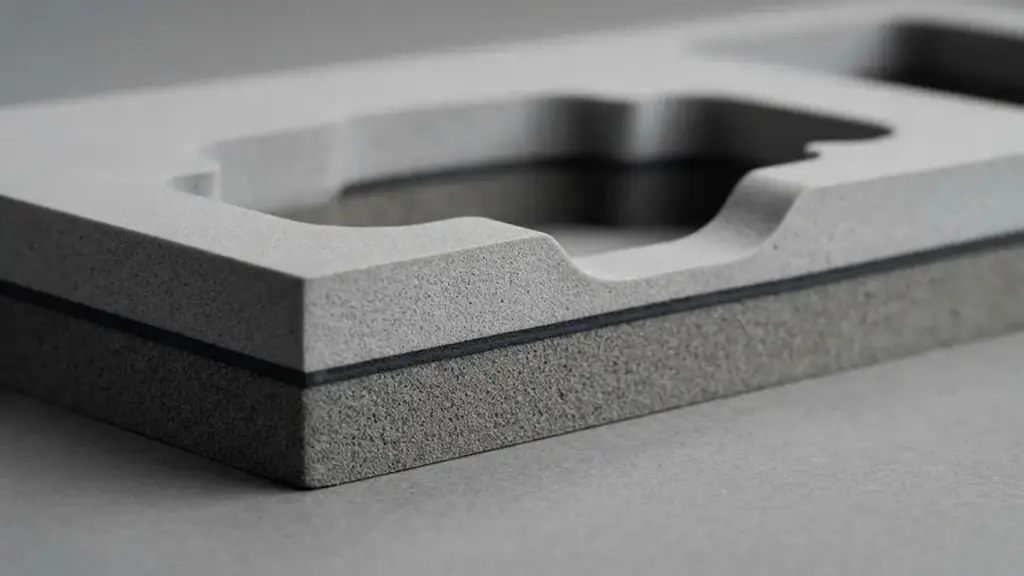
Density and thickness trade against each other in attenuation tests: a thicker, softer pad often beats a thin, dense insert because it stretches the deceleration over a longer distance. Where panel height is fixed, the engineering answer is layering — a soft outer face to manage initial contact over a denser backing to carry the load — which lets you tune the deceleration curve instead of picking one compromise grade.
Choosing the Right Density
Match the grade to the mechanical duty, specify hardness separately, and write both as ranges with tolerances before anyone cuts a tool.
Starting Points by Application
- Protective case inserts: 30–80 kg/m³ covers most instrument and consumer-electronics cradles; heavy tool organisers sit higher, around 80–120, where edges take repeated extraction.
- Footwear and sports components: 80–150 kg/m³ balances cushioning against rebound through repeated dynamic loads.
- Industrial and marine parts: 150–270 kg/m³ where the component carries structural load, resists tearing, or must survive UV and continuous compression.
What Density Does to Weight and Cost
Sheet weight scales linearly with density and gauge: um 5 mm sheet at 25 kg/m³ carries about 125 g per square metre, the same sheet at 80 kg/m³ about 400 g. For a finished 1,000 × 2,000 mm panel at 10 mm and 80 kg/m³, that works out near 1.6 kg — multiply through your own volumes before air-freight quotes surprise your landed-cost model.
On the cost side, the driver is polymer content: a denser sheet contains more raw material per unit volume, so it commands a higher price per sheet or per cubic metre before any conversion steps. Because pricing is quoted per unit of area or volume, comparing two quotes is only meaningful at identical density and gauge — a cheaper sheet that arrives at double the density is not cheaper. Fillers complicate the reading further: a calcium-carbonate-loaded grade can weigh in as “high density” while adding stiffness and price without adding cushioning value, which is why the datasheet should declare filler content where it matters to your application.
The Sourcing Sequence
Five checkpoints turn a band name into a repeatable purchase, em ordem:
- Define the duty: load type, static or dynamic, drop heights if any, temperature range, exposição a fluidos ou luz solar, e vida útil necessária.
- Write the RFQ with numbers, not labels: density range with tolerance, hardness with scale and tolerance, gauge, skin treatment, and the named test standard from the measurement section above.
- Prototype either side of target: order grades one band up and one down, and stress-test them under your own conditions to find where bottoming-out or excess stiffness begins.
- Approve a sample and freeze the specification in writing: densidade, hardness, gauge, cor, filler status, and any lamination, so substitutions have something to be checked against.
- Verify each production lot against the frozen spec: weigh and measure incoming sheets against the approved sample, with agreed acceptance limits before material enters your line.

Perguntas frequentes
What density is EVA foam?
There is no single figure: commercial grades span roughly 20 para 270 kg/m³ (about 1.2 para 16.9 PCF). General-purpose closed-cell sheet falls in the lower half of that span, with protective case liners clustered around 30–80 kg/m³ and structural grades near the top.
Is higher-density EVA foam better?
Não universalmente. Higher density improves load support, cut-edge detail, and resistance to permanent set, but it also raises weight, cost, and the peak force transmitted in a low-energy impact. Where light weight, flex, and soft cushioning lead the design, a lower grade is the better specification.
What is the difference between density and hardness in EVA foam?
Densidade é massa por unidade de volume (kg/m³ or PCF); hardness is the surface’s resistance to a durometer indentor, read on scales such as Shore 00, Costa C, or Shore A. Vinyl acetate content, crosslinking, and fillers let two foams share a density and feel completely different, so both values belong on the specification.
What does “80 kg EVA foam” mean, and how do you calculate sheet weight?
It means a density of 80 kg per cubic metre, not an 80 kg sheet. Weight follows from volume × density: um 10 mm sheet measuring 1,000 × 2,000 mm holds 0.02 m³, so at 80 kg/m³ it weighs about 1.6 kg.
What EVA foam density is best for protective cases?
For most instrument and electronics cases, a medium grade around 50–100 kg/m³ balances shock absorption against cutout durability; very light items can drop to 30–50, while heavy tools and load-bearing dividers pull up toward 80–120. Confirm the pairing with hardness and wall thickness rather than density alone.
Considerações Finais
Density is a procurement control variable, not a quality badge. The reading tells you how much polymer backs each cubic metre of foam; what that delivers in the field depends on the company it keeps — hardness on the right Shore scale, gauge, geometry, and the compression-set limit written beside it. Sheets accepted on a nominal datasheet number, with skins and fillers unaccounted, are where both collapse complaints and over-budget quotes come from.
Write the ranges, test either side of your target under real duty conditions, and freeze the specification before volume runs. At our end, verification against that frozen spec is routine: every order is fully inspected, shells are moulded from 75° Shore C, 6 mm stock by default, and REACH and RoHS-compliant materials are the starting point rather than a surcharge. If your current inserts read too soft, too heavy, or inconsistent between lots, a sample kit across the density and hardness bands is the quickest way to settle the question with your own hands.