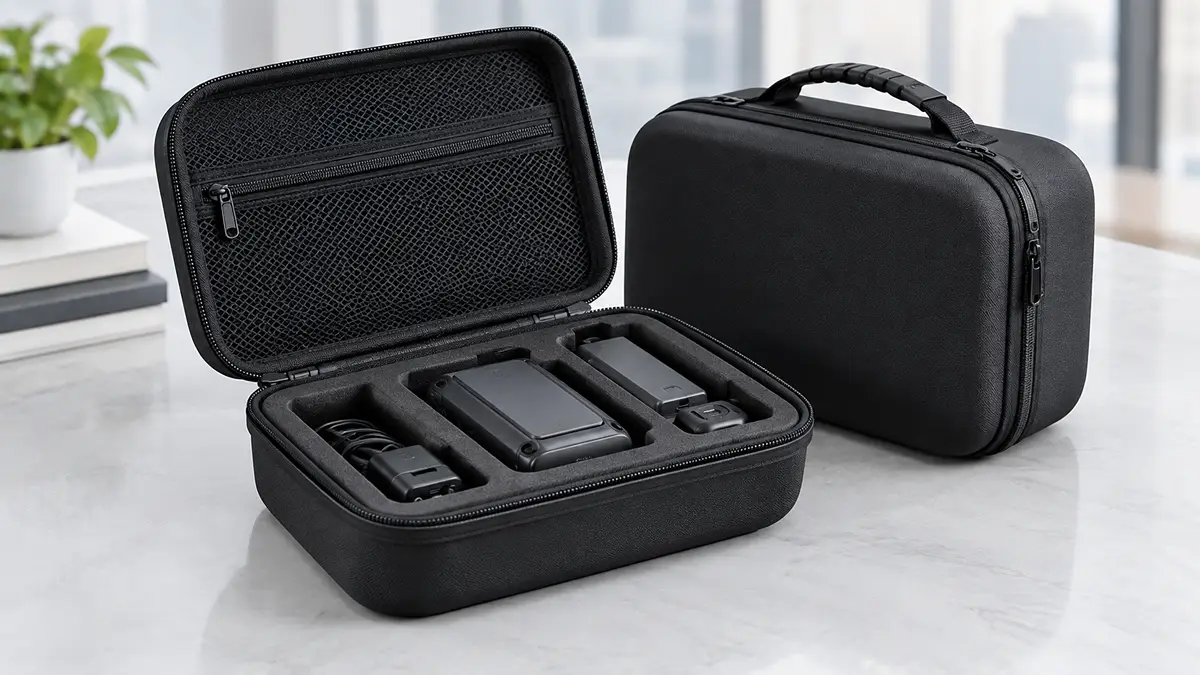
Cross-linked PE foam usually fails a B2B project in one of two ways. Either the material is specified by a label nobody verifies, or its limits are assumed to match a supplier’s best-case technical sheet. Both routes end the same: parts that take a permanent set in the field, or a quote priced for a grade the application never needed.
This guide covers what cross-linking actually changes in polyethylene, how the foam is made, which properties you should see on a supplier’s spec sheet, how it compares with EVA and with standard PE foam, where it earns its cost, and how to verify a claim before you commit to a production run.
What Is Cross-Linked Polyethylene Foam
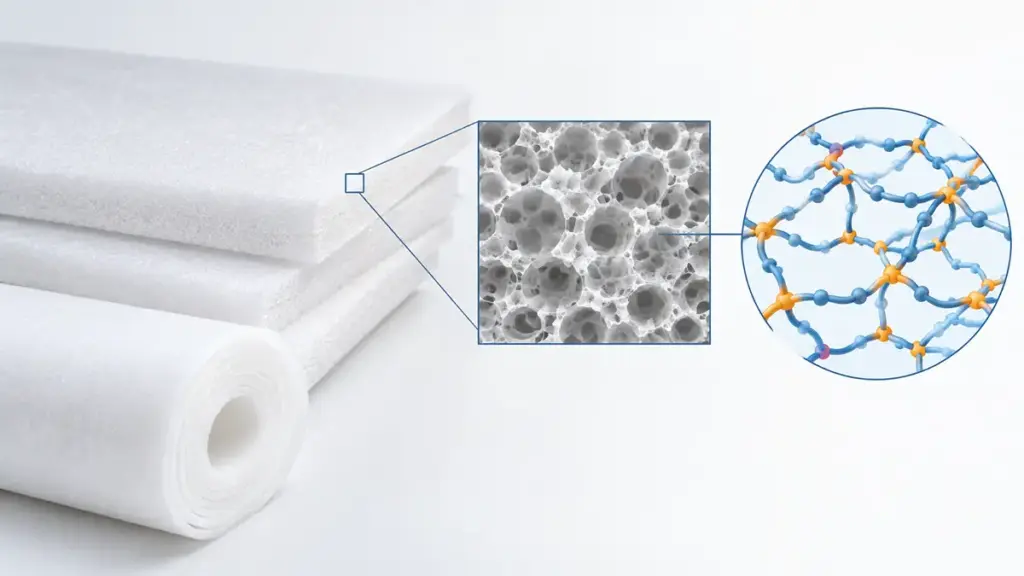
Why does ordinary foam packaging recover once and then stay flattened? The answer is in the polymer chains, not in the cell size.
Cross-linked PE foam (Xlpe) is polyethylene whose chains are joined by covalent bonds into a three-dimensional network, which is what gives the closed-cell structure its heat tolerance, low water uptake, and load recovery.
Standard polyethylene is a bundle of independent chains that slide past each other when the material is heated or held under load. Cross-linking ties those chains together, so the structure behaves less like a thermoplastic and more like a resilient network that returns to shape once the force is released.
Two Ways to Build the Network
Industrial supply splits by how the bonds are created, and the route taken affects cell uniformity, surface finish, and price:
- Chemical cross-linking: a peroxide additive is blended into the resin and activated by heat during production, forming the bonds in the extrusion and furnace stages.
- Electron-beam (irradiation) cross-linking: the sheet passes under an accelerator that generates the bonds directly, typically giving a finer, more uniform cell and a smoother skin, at higher processing cost.
Xlpe, Xpe, IXPE: What The Labels Mean
The three names describe one material family, not three grades, and suppliers use them inconsistently. Treat XLPE and XPE as interchangeable labels for cross-linked polyethylene; IXPE is generally used for the irradiation route. Because a label carries no performance guarantee, the useful questions to put to a supplier are the cross-link method, the measured gel content, and the density of the actual lot, not which abbreviation appears on the price list.
How Cross-Linked PE Foam Is Made
A sequenced thermal process: compound, extrude a solid mother sheet, cross-link the network, expand it in a furnace, then cool and convert. Each stage sets a property you will later measure.
| Stage | What happens | What it controls downstream |
|---|---|---|
| Compounding | LDPE resin is blended with a peroxide cross-linker and a blowing agent such as azodicarbonamide, mixed under controlled temperature so neither activates early. | Cell uniformity; dispersion failures show up as local weak points. |
| Mother sheet | The compound is extruded through a flat die into a solid, unfoamed sheet at a melt temperature held below the activation range of both additives. | Gauge tolerance and the geometry of the final expanded board. |
| Cross-linking | Heat decomposes the peroxide, generating free radicals that link neighbouring chains (gel content measurement is the usual check). The irradiation route achieves the same result before expansion. | Melt strength, which decides whether expanding gas is retained or escapes. |
| Expansion | In hotter furnace zones the blowing agent decomposes, releasing gas that nucleates closed cells while the cross-linked walls stretch without rupturing. | Final density, expansion ratio, and cushioning behaviour. |
| Cooling & converting | Water-cooled rolls or forced air freeze the dimensions; the material is then conditioned, trimmed, slit, laminated, adhesive-coated, or embossed. | Flat lay, thickness consistency, and how much shrinkage or warp appears later. |
Temperature is the recurring variable. Early gas release in the barrel costs expansion in the furnace, and skipped conditioning costs dimensional stability months after delivery. This is why the same nominal grade can behave differently between two suppliers.
Two further process decisions explain most of the price spread you will see quoted for “the same” материал. A higher cross-link density costs furnace time and money, and it is what separates a gasket that holds its load after a year from one that has quietly thinned. Surface skin is the other: an irradiated sheet leaves a denser, smoother face that takes print and adhesive more reliably, which is why converters pay a premium for it and why a laminate that delaminates six months later is often a skin question rather than an adhesive question.
Properties And Typical Specifications
Published ranges for cross-linked PE foam are wide. Use them to read a quote, not to sign off a part — the governing document is the supplier’s technical data sheet for the lot you buy.
| Свойство | Typical published range | Why it matters on a spec sheet |
|---|---|---|
| Плотность | Roughly 28 к 200 kg/m³ across commercial grades | Single lever for weight, stiffness, и стоимость; most packaging and insulation grades sit well below the top of the range. |
| Thermal conductivity | Commonly quoted near 0.033 к 0.045 W/m·K, varying with density and test method | Compare suppliers only at the same density and the same standard; otherwise the numbers are not measuring the same thing. |
| Service temperature | Frequently stated from about -40°C up to roughly 100°C, with short-term peaks higher | Defines forming, hot-climate shipping, and engine-bay use; confirm continuous versus intermittent exposure. |
| Water absorption | Generally below 0.5% by volume after 24-hour immersion, measured to ASTM D3575 or ISO 2896 | ASTM D3575 и ИСО 2896 use different parameters and are not interchangeable; state which one the report follows. |
| Tensile and elongation | Scales with density; specific figures belong on the lot TDS rather than in a brochure | Cross-linked grades keep their values better after heat exposure than unlinked foam of the same density. |
| Compression set | Lower than non-cross-linked PE of equal density, in most published comparisons | The number to watch for gaskets, уплотнения, and anything held under sustained load. |
Reading The Density Band
Within the published range, the bands are predictable enough to brief a supplier with. Low densities buy insulation value and buoyancy per kilogram rather than strength, and are where most underlay, liner, and flotation grades live. Mid densities are the general-purpose zone for protective packing and formed seals, where handling damage, not weight, is the limiting factor. The upper end is reserved for parts that carry structural load or must hold a tight tolerance after die cutting, and it is also where material cost per finished part climbs fastest, since you are paying for polymer that insulation duty does not need.
Chemical And Environmental Behaviour
The polyolefin base is largely inert, which is why the foam tolerates dilute acids, common alkalis, and many technical fluids without obvious attack. Two limits are worth writing into a specification. Unprotected outdoor exposure degrades surface appearance and strength unless carbon black, a UV stabiliser, or a protective laminate is called up. And a low absorption figure is a bulk property: клеи, textile laminates, and unsealed seams introduce their own moisture paths, regardless of how well the foam itself performs.
EVA behaves differently on both counts. The vinyl acetate content is what gives EVA its softness and grip, and it is also the part of the molecule that plasticisers, масла, and some solvents attack over time. Heat is the other split: EVA’s upper continuous limit sits below that of a cross-linked PE of comparable density, which is why a case that ships in a sun-loaded container or sits near a heat source is a cross-linked-foam conversation, and a case that is dropped on a workshop floor is not.
Why The Closed Cell Drives The Water Claim
Discrete gas-filled cells cut off the capillary paths that let open-cell materials wick liquid, and polyethylene does not absorb water at the molecular level. In practice the difference between water-resistant and waterproof is workmanship: punctures, cuts, and raw cut edges expose cell interiors, cyclic compression fatigues thin walls until local cells rupture, and hydrostatic pressure eventually pushes vapour through even an intact skin. For continuous submersion, specify a secondary vapour barrier rather than relying on the foam alone.
Cross-Linked PE Foam vs EVA
EVA and XLPE are both closed-cell polyolefin workhorses. Neither is universally better; they trade rebound for recovery, and moulded three-dimensional shells for continuous sheet.
| Свойство | Cross-linked PE (XLPE/XPE) | Ева пена |
|---|---|---|
| Base polymer | Cross-linked polyethylene network | Ethylene-vinyl acetate copolymer |
| Surface and feel | Firmer, smooth, slightly waxy | Softer, rubber-like, higher grip |
| Load behaviour | Consistent support, lower rebound, better resistance to permanent set | Superior rebound and impact absorption |
| Химическая стойкость | High against dilute acids and alkalis | Умеренный; certain oils and solvents attack the copolymer |
| Main process | Continuous sheet, then die-cut, skived, or laminated | Compression and thermoforming moulds for complex 3D shapes |
| Typical finish | Smooth skin suited to printing and adhesive lamination | Takes colour, тиснение, and fabric covering well |
Specify XLPE When
The part is flat or rolled, carries a sustained load, sees repeated compression, or has to hold its dimensions through heat and humidity: duct and pipe insulation, flooring underlay, gasket and seal stock, rigid protective packing, marine flotation.
Specify EVA When
The part is a moulded three-dimensional shell, needs rebound rather than support, or is handled and worn close to the body: footwear midsoles, orthotic inserts, спортивные коврики, and the formed shells of protective cases. Case manufacturers, including our own lines, work predominantly in EVA for exactly these reasons; if you are comparing shell materials for a case programme, our breakdown of hard plastic vs EVA medical cases covers the trade-offs from the shell side.
The Practical Rule
Choose by load profile and geometry first, then by chemistry. A part that is compressed and left there wants XLPE. A part that is struck and expected to spring back wants EVA. Sorting out which of those two sentences describes your product removes most of the specification debate before a single sample is ordered.
XLPE vs Standard PE Foam
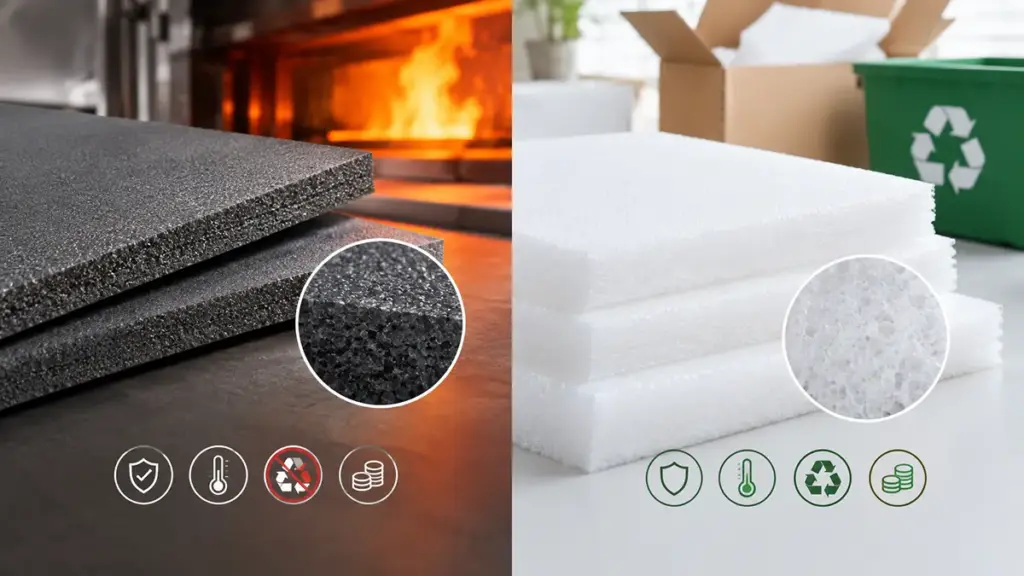
Cross-linking buys durability and heat tolerance at the cost of recyclability and price. Standard PE remains the sensible answer for single-use protection.
- Структура: standard PE foam keeps its chains unlinked, so cells deform under sustained load or heat; the cross-linked network holds cell shape under the same stress.
- Field life: unlinked foam is a low-cost cushion for its first handling cycle and loses thickness quickly after that, which is fine for one-way dunnage and not fine for reusable transit cases.
- Fabrication: standard PE melts and heat-seals easily; XLPE holds dimension through die cutting, slitting, and multi-layer lamination, but cannot be cleanly remelted and is usually reclaimed by grinding.
- Cost logic: the price gap is defensible when a part is cycled, heated, or load-bearing, and hard to justify when it is discarded after one shipment.
If a quote for “На пене” arrives without the cross-link status stated, ask for it in writing alongside gel content. The answer changes both the price conversation and the warranty exposure.
The same logic applies to your own cost model. Standard PE wins whenever the foam is discarded after one journey, because nothing is asked of it after that. The cross-linked grade earns its premium as soon as the part is expected to survive a second cycle in the same condition, which is the entire business case for reusable transit dunnage.
Where Cross-Linked PE Foam Earns Its Cost
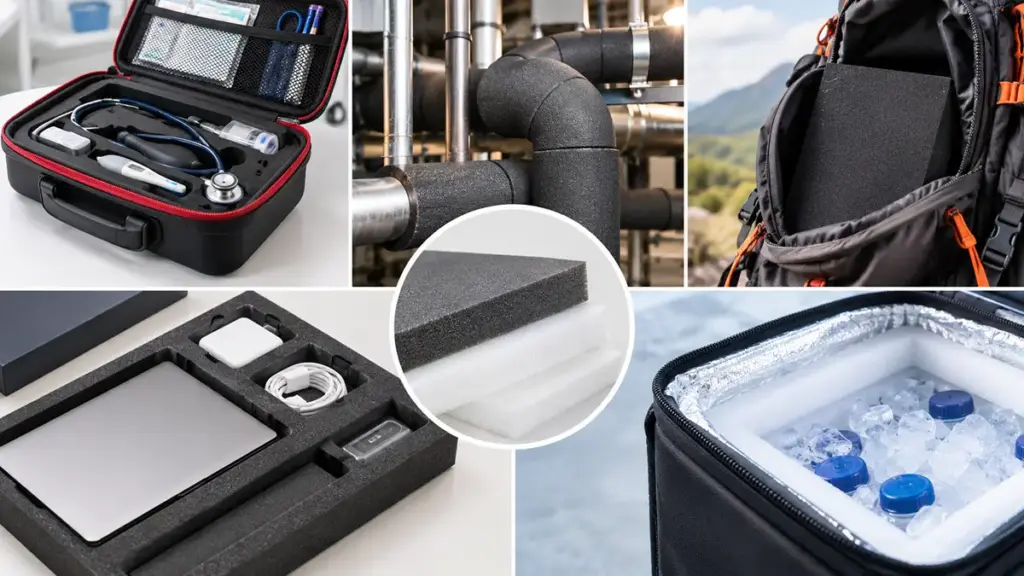
Across industries, the material is specified where its recovery, moisture behaviour, or thermal resistance pays for the premium over standard foam.
Building, HVAC, and Transportation
- Pipe and duct insulation where condensation control matters, because low water uptake keeps the insulating value from decaying in service.
- Flooring underlay, combining impact-noise reduction with a moisture break beneath floating floors.
- Vehicle interiors as acoustic and thermal barriers, and as cushioning and sealing around battery assemblies in electric and hybrid platforms.
Protective Packaging and Cold Chain
- Die-cut corner protectors, cradles, and reusable transit dunnage that survive multiple cycles without thinning out.
- Insulated liners for temperature-sensitive shipments, where repeated wetting and drying would destroy an open-cell alternative. Construction matters as much as material here: a liner is only as good as its seams, so ask how the panels are joined and whether the joint is the same material or a taped overlap.
- Antistatic and conductive grades for electrostatic-sensitive electronics, specified by surface resistivity rather than by colour.
Sport, Marine, and Regulated Use
Buoyancy components, коврики, and outdoor pads rely on the same hydrophobic closed cell, with UV protection added where the part lives in sunlight. Medical and skin-contact applications are a different conversation: the polymer itself is inert, but grades intended for prolonged contact should be evaluated against a recognised biocompatibility protocol such as ISO 10993, with the test report supplied by the manufacturer rather than assumed.
How To Source It Without A Surprise
The gap between a data sheet and a delivered part is where most material disputes start. Five checkpoints close it, in order:
- Define the duty first. Load type, duration, temperature, exposure to fluids or sunlight, and required service life. A spec written from performance requirements is auditable; a spec copied from a brochure is not.
- Ask for the lot documents. Плотность, cross-link method, gel content, water absorption with the test standard named, and a full technical data sheet.
- Approve physical samples, not photographs, and test them under your own conditions rather than the laboratory’s.
- Freeze the specification in writing: плотность, cross-link route, skin configuration, thickness tolerance, colour, and any lamination or adhesive system.
- Verify each production lot against the frozen spec and the approved sample, with agreed acceptance limits, before the material enters your line.
Whichever foam finally wins the decision, the case or component around it is where the protection is actually delivered. Наш custom EVA medical case guide walks through the matching process on the shell side, from drawing review to sample approval.
Часто задаваемые вопросы
What is cross-linked PE foam used for?
It is specified where a foam must recover under load, resist moisture, or hold its properties through heat: insulation for pipes and ducts, flooring underlay, automotive acoustic and thermal barriers, gaskets and seals, reusable protective packaging, marine flotation, and antistatic electronics packing. Selection should follow the duty, not the material name.
Is cross-linked PE foam better than EVA?
Not universally. Cross-linked PE generally gives better dimensional stability under sustained load, lower compression set, and stronger chemical resistance, while EVA gives softer feel, higher rebound, and easier moulding into complex three-dimensional shapes. Pick XLPE for support and flat goods, EVA for impact return and moulded shells.
Is XPE foam waterproof?
Its closed cells make it highly water-resistant, and published absorption figures for good grades typically land below 0.5% by volume after 24-hour immersion. System performance depends on intact skin and seams: cut edges, punctures, adhesive lines, and sustained hydrostatic pressure all give water a path, so continuous submersion needs a secondary vapour barrier.
Does cross-linked PE foam contain formamide?
Formamide is not an ingredient of polyethylene, but residues can appear where azodicarbonamide was used as the blowing agent. If formamide content is restricted in your market or application, ask for a laboratory report against the applicable limit, or specify irradiation-cross-linked grades, which typically avoid chemical blowing agents.
Can cross-linked PE foam be recycled?
Not by ordinary remelting: the cross-linked network behaves like a thermoset, so reclamation normally means grinding into rebonded filler or padding. Standard unlinked PE foam, by contrast, can re-enter polyethylene streams. If recyclability is a procurement requirement, raise it before specifying, because it trades directly against load recovery.
Заключительные мысли
Cross-linking is not a quality grade, it is a structural choice: it buys recovery under load, теплоемкость, and stable closed cells, and it costs remelt recyclability and price. Once that trade is clear, most of the arguments about XLPE, Xpe, and IXPE labels stop mattering, and the questions that do matter are density, cross-link method, gel content, and the test standard behind every number.
Verify those against your own duty conditions and freeze the specification before volume runs. If the end product is a case rather than a sheet of foam, start with a drawing review so the material selection and the shell design are settled in the same conversation.